
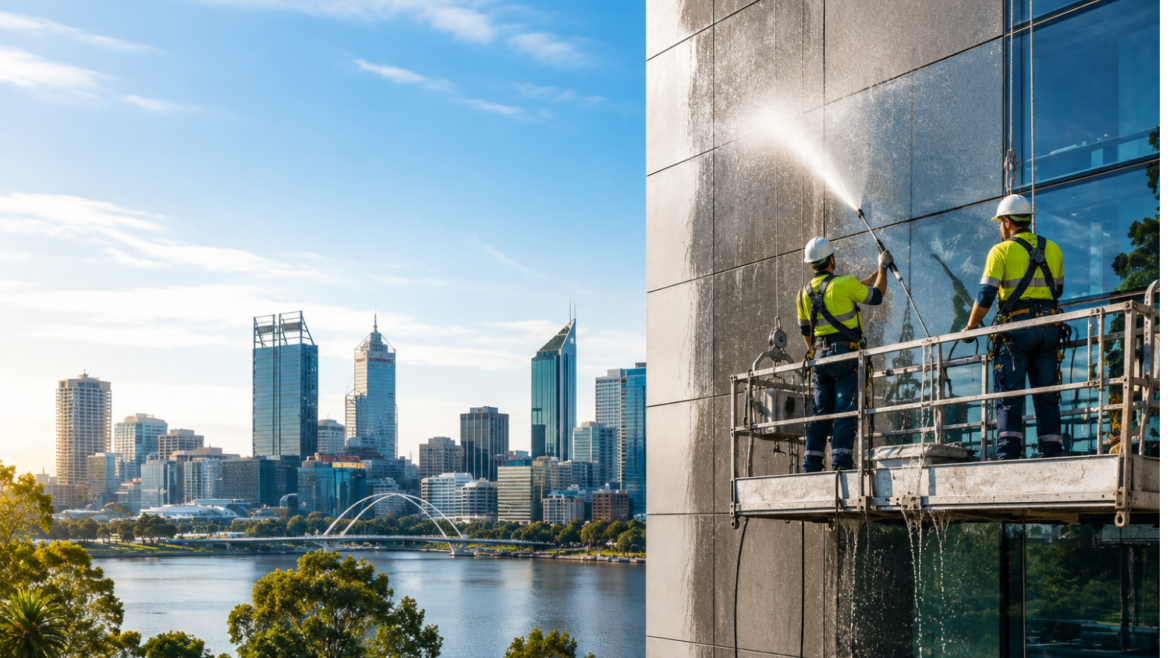
Your building’s facade works hard. Every day it absorbs Perth’s dust-laden easterlies, coastal salt air, UV radiation, and biological growth from birds and organic debris. Unlike most Australian capital cities, Perth’s climate does not give facades a break. The result is accelerated soiling that, left unchecked, moves from cosmetic to structural faster than most facility managers expect.
The question of how often to clean a commercial building facade is one of the most common ones property and facility managers ask. The honest answer depends on your building type, height, location, and the materials used on the facade. What is consistent is this: reactive cleaning costs more than scheduled maintenance, and permanent damage is always more expensive than prevention.
This guide gives you a practical frequency framework based on Perth conditions, building categories, and what actually happens when cleaning is delayed too long.
Key Takeaways
- Most Perth commercial buildings need professional facade cleaning every 6 months
- Buildings within 5km of the coast require more frequent attention due to salt air corrosion
- Delaying facade maintenance beyond 18 months significantly increases the risk of permanent staining and seal failure
- Building height, facade material, and surrounding environment all affect cleaning frequency
- A professional inspection is the most accurate starting point for setting a maintenance schedule
Why Perth Buildings Need More Frequent Facade Cleaning Than Most Cities
Perth sits in a unique environmental position that accelerates facade deterioration compared to cities like Melbourne or Adelaide. Understanding those forces is the first step in setting a realistic maintenance schedule.
- Dust and Airborne Particles
Perth is one of the dustiest capital cities in Australia. Easterly winds regularly carry fine red-brown dust from the interior across the metropolitan area, and it settles into porous facade materials including rendered brick, textured cladding, and stone panels. Fine dust also builds up on glass surfaces and begins attracting moisture, which over time creates the conditions for biological growth.
- Coastal Salt Air
Approximately two-thirds of Perth’s commercial building stock sits within 20km of the coast. For buildings within 5km of the Indian Ocean or Cockburn Sound, salt air is a direct structural threat. Salt deposits on metal frames, cladding fixings, and window seals and begins an ongoing corrosion process. Left untreated, this progresses from surface staining to compromised seals and eventually to metal fatigue in facade fixings.
- UV Radiation
Perth consistently records some of the highest UV index levels in the world. This affects facade materials in two key ways. First, UV degrades the sealants around window frames and cladding joints, reducing their ability to keep moisture out of the building envelope. Second, UV breaks down surface coatings and paint, making them porous and more likely to absorb soiling. A facade that has not been cleaned or re-sealed regularly is one that UV radiation is quietly working against.
- Biological Growth
Perth’s warm, humid winters create ideal conditions for algae, mould, and lichen on north-facing and shaded facade surfaces. Bird activity adds guano deposits that are highly acidic and etch glass and stone surfaces within months of contact. Once lichen establishes on a facade, removal requires specialist treatment and becomes significantly more expensive than standard cleaning.
Regular Cleaning Costs Less Than Major Building Repairs
Commercial Facade Cleaning Frequency Guide by Building Type
Use this as a starting point. A professional site inspection will always give you a more accurate maintenance schedule based on your specific building’s condition, materials, and exposure.
High-Rise Commercial Buildings (10 or More Storeys)
Recommended frequency: every 6 months.
At height, facades are exposed to higher wind speeds, more UV, and greater accumulation of airborne dust and pollution. Glass curtain wall buildings show soiling more visibly and tend to receive the most complaints from tenants. Buildings in the Perth CBD that face the coast or sit near major road corridors benefit from 6-monthly cleaning to maintain presentation and prevent salt and pollution build-up on glass and aluminium surfaces.
Mid-Rise Office and Retail Buildings (4 to 10 Storeys)
Recommended frequency: every 6 months.
Annual cleaning is the minimum standard for mid-rise commercial buildings in Perth. Buildings located near major roads, the coast, or active construction sites should move to a 6-monthly schedule. For strata office or commercial buildings, facade cleaning is typically a common property obligation under the owners corporation, and the schedule should be set in the annual maintenance budget.
Low-Rise Commercial and Retail (Under 4 Storeys)
Recommended frequency: every 3 – 4 months.
Ground-level commercial buildings generally accumulate soiling more slowly at height but often have greater exposure to vehicle exhaust, pedestrian activity, and ground-level pollution. Retail shopfronts with significant glass frontage often need more frequent attention to maintain customer-facing presentation.
Buildings Within 5km of the Coast
Recommended frequency: every 4 months, regardless of building height.
Coastal proximity is the single biggest accelerator of facade deterioration in Perth. Salt deposits are corrosive to every facade material class and begin working immediately after deposition. Buildings in suburbs such as Fremantle, Cottesloe, Scarborough, Hillarys, and Rockingham should be on a minimum bi-annual cleaning and inspection schedule.
| Building Type | Location | Recommended Frequency |
|---|---|---|
| High-rise (10+ storeys) | Perth CBD / metro | Every 6 months |
| Mid-rise (4 to 10 storeys) | Metro / suburban | Every 6 months |
| Low-rise (under 4 storeys) | Metro / suburban | Every 3–4 months |
| Any height | Within 5 km of coast | Every 4 months |
| Any height | Near construction / busy road | Every 4 months |
What Happens When Facade Cleaning Is Delayed?
The cost of reactive cleaning is almost always higher than scheduled maintenance. Here is what actually happens when facade cleaning is pushed beyond the recommended intervals.
Staining Becomes Permanent
Algae, lichen, and mineral deposits do not just sit on the surface of a facade. They penetrate porous materials and etch glass. After 12 months of growth, standard pressure washing is no longer sufficient. Specialist chemical treatment is required, and on natural stone or textured render, permanent discolouration may remain even after treatment.
Sealant and Joint Failure
Window seals and caulking joints around cladding panels degrade faster when covered in biological growth, salt residue, and UV-exposed soiling. Once a seal fails, water enters the building envelope. What begins as a cleaning issue becomes a waterproofing repair one of the most common and expensive reactive maintenance jobs Perth facility managers face.
Cladding and Fixings Corrosion
Metal cladding, aluminium window frames, and the fixings that hold facade panels in place are all vulnerable to salt and biological acid corrosion. Annual cleaning removes the corrosive agents before they have time to work. Buildings that go three or more years without cleaning often face partial cladding replacement that dwarfs the cost of years of scheduled cleaning.
Tenant Dissatisfaction and Vacancy
In Perth’s commercial property market, building presentation is directly linked to tenant retention. Facility managers consistently report that dirty facades and streaked windows are among the top complaints from commercial tenants. A building with visible soiling signals underinvestment to prospective tenants and reduces the building’s ability to command premium rents.
How to Build a Facade Maintenance Schedule for Your Perth Building
Step 1: Get a baseline inspection.
Before setting any cleaning frequency, have a professional assess the current condition of the facade. This identifies existing staining, sealant condition, biological growth, and any corrosion that needs to be addressed first. Our building facade maintenance and repairs in Perth service covers full facade assessment as well as cleaning and repair.
Step 2: Set your interval based on building type and location.
Use the frequency guide above as your starting point. If your building is near the coast, near a major road, or has a history of algae problems, start at the shorter end of the recommended range and extend if the results support it.
Step 3: Align cleaning to Perth’s seasons.
Post-summer cleaning in April or May removes the dust, UV degradation, and salt accumulation from Perth’s long, dry summer. Post-winter cleaning in September or October removes algae, mould, and moisture residue from winter rainfall. Scheduling around these periods maximises the effectiveness of each clean.
Step 4: Bundle with height safety recertification.
If your building has anchor points installed, the annual facade cleaning visit is a logical time to conduct the annual anchor inspection at the same time. Read our guide on anchor point inspection requirements for Perth buildings for a full breakdown of what is required and how often.
Step 5: Keep a maintenance log.
Document every cleaning visit with a date, scope of work, contractor name, and any observations about facade condition. This record is useful for insurance purposes, strata annual reports, and as evidence of due diligence if a facade-related liability issue ever arises.
Signs Your Building Facade Needs Cleaning Now
- Visible green, black, or orange biological growth on any facade surface
- White or grey calcium or salt deposits on glass near air conditioning units or at cladding joints
- Streaking or tide marks on rendered walls or glass panels after rain
- Bird guano deposits that have been in place for more than a few weeks
- Discolouration or dark staining on north-facing or shaded areas of the facade
- More than 18 months since the last professional clean
Frequently Asked Questions
How often should a commercial building facade be cleaned in Perth?
Most Perth commercial buildings need professional facade cleaning every 6 months depending on height, location, and cladding type. Buildings within 5km of the coast should be cleaned every 6 months due to the accelerated corrosion caused by salt air.
What does commercial facade cleaning cost in Perth?
Cost depends on building height, access method, facade size, and the level of soiling. Perth commercial buildings are typically quoted after a free site inspection. Contact Masters Co for an obligation-free assessment of your building.
Can facade cleaning prevent structural damage?
Yes. Regular cleaning removes corrosive agents including salt, guano, algae, and biological acids before they degrade sealants, cladding fixings, and building materials, significantly reducing long-term repair costs and extending the service life of facade components.
Is facade cleaning the strata owners corporation’s responsibility?
In most strata schemes, the external facade is common property and the owners corporation is responsible for its maintenance. Cleaning frequency and contractor selection are typically included in the annual maintenance programme approved at the AGM.
What method is used to clean commercial building facades in Perth?
Method depends on building height and facade material. Rope access, elevated work platforms, water-fed pole systems, and pressure washing are all used depending on the specific building, access, and type of soiling present.
A Clean Facade Protects Your Building and Your Tenants
Facade maintenance is not something to schedule when it looks overdue. By the time soiling is visible to tenants and visitors, the corrosive process has already been underway for months. Perth’s dust, salt, and UV environment means buildings here age faster externally than equivalent buildings in most other Australian cities.
Setting a regular cleaning schedule based on your building type and location is the most cost-effective thing a facility manager or property owner can do to protect a high-value commercial asset. Masters Co has been maintaining Perth commercial buildings since 1998, from Mandurah to Joondalup, using IRATA-certified technicians and proven access methods suited to every building type.
