
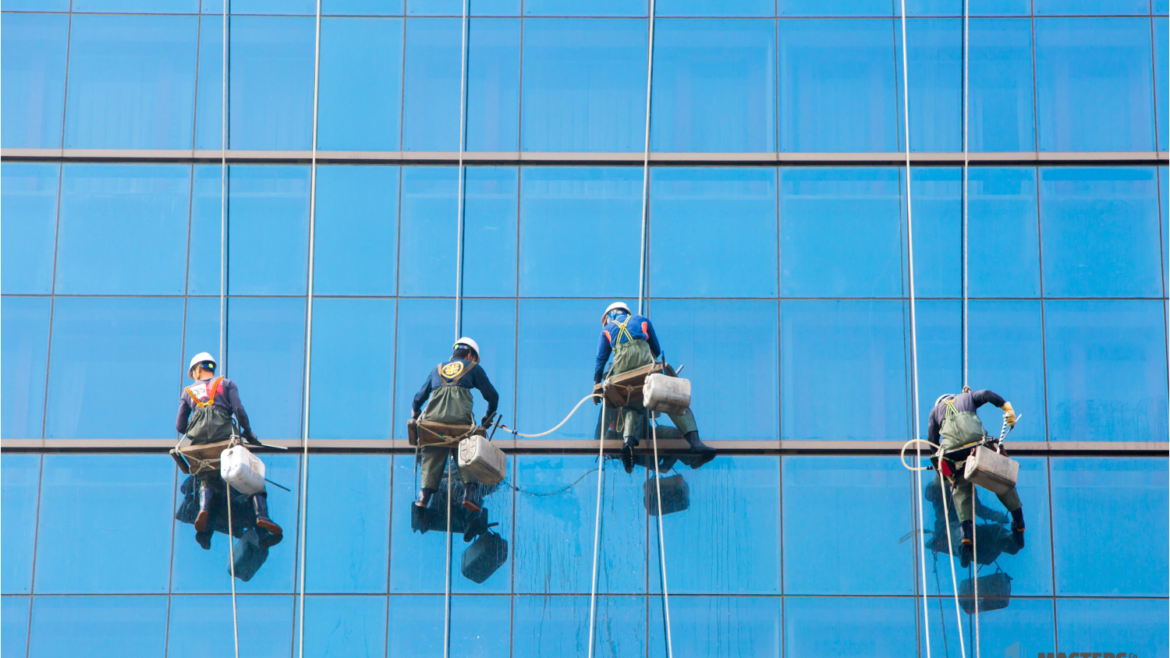
Not all buildings can be cleaned the same way. The method used to clean high-rise windows in Perth depends on building height, architectural design, available anchor infrastructure, site access conditions, and the type of glass and facade being serviced.
Strata managers, facilities managers, and building owners often encounter multiple providers quoting different methods for the same building. Understanding what each method involves, where it works well, and where it has limitations makes it easier to ask the right questions and select the right service.
This guide covers the four main methods used for commercial and high-rise window cleaning in Perth, rope access, Elevated Work Platforms, water-fed poles, and Building Maintenance Units, explaining the practical conditions that determine which approach is appropriate for a given building.
Key Takeaways
- Rope access is the most versatile method for high-rise window cleaning in Perth, suitable for buildings of any height with anchor points installed and no site access limitations.
- Water-fed poles using pure water technology are efficient and cost-effective for buildings up to approximately five storeys, eliminating the need for height access equipment on low to mid-rise structures.
- Elevated Work Platforms suit low to mid-rise buildings where ground conditions allow boom truck positioning and no overhead obstructions prevent safe operation of the extended arm.
- Perth’s coastal environment, the Fremantle Doctor sea breeze, and summer wind conditions all influence method selection and safe working windows throughout the year.
Why Window Cleaning Method Selection Matters
Choosing the wrong method for a building has practical consequences. An EWP that cannot reach upper floors due to an awning or setback leaves sections of the building uncleaned. A water-fed pole system used on a 12-storey building produces poor results regardless of operator skill. Rope access on a building with uncertified anchor points creates legal and safety exposure that no reputable contractor will accept.
For building owners and managers, understanding the four main methods provides a basis for evaluating contractor proposals. A provider who quotes a single method regardless of building characteristics is worth questioning. The right provider assesses the specific conditions of each property before selecting an approach.
The condition and certification status of a building’s anchor infrastructure directly affects which methods are available. More on how anchor systems support both cleaning and maintenance access is covered in the guide to height safety inspection and anchor point certification in Perth.
Not Sure Which Cleaning Method Fits Your Building?
Method 1: Rope Access
Rope access is the most versatile and widely used method for high-rise window cleaning on Perth’s commercial, strata, and mixed-use buildings. It is the method of choice where height, building geometry, or site access conditions preclude the use of mechanical equipment.
How Rope Access Works
Rope access window cleaning involves IRATA-certified technicians working from ropes rigged to certified anchor points on the building’s roof. Each technician works on a primary rope with a secondary safety rope as a backup. The technician descends the building face, cleaning windows and glass surfaces from a suspended position, then ascends to reposition for the next pass.
The IRATA system, developed by the Industrial Rope Access Trade Association, sets the global standard for rope access work. IRATA certification is awarded at three levels, from Level 1 technician through to Level 3 supervisor, and requires documented hours of work at height, practical assessments, and ongoing revalidation. In Perth, IRATA certification is the recognised credential for rope access cleaning on commercial buildings.
What Rope Access Suits
- High-rise and super-tall buildings: Any building above the effective reach of an EWP or water-fed pole. Once above approximately seven storeys, rope access is typically the only practical method for exterior window cleaning.
- Buildings with complex geometry: Angled facades, recessed windows, protruding architectural elements, and complex curtain wall designs that a boom cannot reach are all navigable by an experienced rope access technician.
- Tight site access: Where ground conditions prevent an EWP from being positioned, narrow streets, confined courtyards, established landscaping, or underground car parks with limited load-bearing capacity, rope access operates entirely from the roof, independent of ground conditions.
- Buildings where minimal disruption is required: Rope access work requires no road closure, no occupation of car park space, and no presence of heavy machinery near building entries. For occupied office towers, hotels, and strata buildings where tenant disruption must be minimised, this is a significant operational advantage.
Requirements and Limitations
Rope access requires certified anchor points on the building’s roof. A building without installed, tested, and currently certified anchor infrastructure cannot support rope access window cleaning until a compliant system is installed and certified. This is among the most common reasons a building requires new height safety installation before its first rope access cleaning programme can commence.
Wind is the primary operational constraint. Perth’s Fremantle Doctor, the strong afternoon sea breeze that arrives reliably in summer from the southwest, creates a defined safe working window for rope access on exposed west-facing and south-facing facades. Experienced Perth rope access operators plan work in these conditions to utilise morning hours before the sea breeze arrives, or operate on sheltered faces while the breeze is active. Severe wind events suspend all rope access work.
Method 2: Elevated Work Platforms (EWPs)
An Elevated Work Platform, commonly called a cherry picker or boom lift, uses a hydraulic arm mounted on a vehicle to extend a work platform alongside the building face. The operator or cleaner works from the platform while the vehicle remains stationary on the ground.
How EWPs Are Used for Window Cleaning
For window cleaning, the boom is extended to position the cleaning operator alongside each window, working their way systematically around the building. EWPs can typically reach up to around 50 to 60 metres in height for the largest boom trucks, though the practical working height for window cleaning is often less due to the reach angle needed to access the building face directly.
What EWPs Suit
- Low to mid-rise buildings: Commercial office buildings of three to eight storeys, strata complexes, retail buildings, and warehouses with glazed facades where rope access would be logistically complex and a boom can access the full building height.
- Buildings with regular, vertical facades: Flat glazed exteriors without architectural projections or setbacks that would prevent the boom from reaching the glass directly are well suited to EWP cleaning.
- Buildings where ground access is available: EWPs require firm, level ground to operate safely, and sufficient clear space to position the vehicle and extend the boom without obstruction. Car parks, wide footpaths, and open grounds adjacent to the building facilitate EWP deployment.
Limitations in Perth’s Urban Environment
Perth’s CBD and inner-suburban commercial precincts often present access challenges that limit EWP deployment. Narrow streets require road occupancy permits. Footpath occupation may need council approval. Underground car parks cannot support the vehicle weight. Awnings and canopies at lower levels may prevent the boom from reaching upper floors without relocating the vehicle.
Perth’s summer heat also affects EWP work. Operators working in an open platform without shade at height in 38 to 42-degree conditions face heat stress risks that must be managed through careful scheduling, hydration protocols, and early morning start times before temperatures peak.
Method 3: Water-Fed Pole Systems
Water-fed pole cleaning is a ground-based method that uses a telescopic carbon fibre pole with a brush head to clean windows from below. Purified water is pumped through the pole to the brush, cleaning the glass without chemicals and leaving it to dry spot-free.
How Pure Water Technology Works
Tap water contains dissolved minerals that leave white spots on glass as the water evaporates. Pure water, processed through reverse osmosis and deionisation to remove these minerals, evaporates cleanly without leaving residue. This is the basis of the water-fed pole method: the glass is scrubbed with pure water and left wet, drying naturally to a spot-free finish without a squeegee or drying cloth.
Masters Co uses Pure Water Technology as part of its commercial cleaning programme, particularly for buildings where the lower floors can be serviced from the ground while upper floors require rope access or EWP for higher levels.
What Water-Fed Poles Suit
- Buildings up to approximately five storeys: The pole can be extended to around 15 to 18 metres in calm conditions, equivalent to roughly four to five storeys. This covers the majority of two to four-storey commercial properties and the lower floors of taller buildings.
- Regular maintenance cleans: Water-fed pole cleaning is particularly effective for regular maintenance visits where windows are not heavily soiled. The method is faster than traditional hand-cleaning at accessible heights and produces consistent results.
- Environments where chemical use is restricted: Hospitality venues, healthcare facilities, schools, and buildings in proximity to water features or vegetation often prefer pure water cleaning for its chemical-free approach.
Perth-Specific Considerations
Perth’s strong afternoon sea breeze, the Fremantle Doctor, creates practical challenges for water-fed pole work on exposed facades. The wind disperses the water stream and can carry spray onto adjacent surfaces or into building openings. Early morning scheduling on days with expected afternoon wind events manages this risk effectively.
Perth’s hard water supply also makes pure water technology particularly relevant. Standard tap water in Perth has moderate mineral content that would leave significant spotting on glass if used without treatment. The purification process that makes water-fed pole cleaning effective is especially valuable in Perth’s water conditions.
How Perth’s Climate Affects Method Selection
Perth’s climate creates specific conditions that affect how and when each cleaning method can be safely deployed. Building managers benefit from understanding these factors when scheduling maintenance programmes.
The Fremantle Doctor
The Fremantle Doctor is the strong afternoon sea breeze that arrives from the southwest on most days from October through April, sometimes reaching wind speeds above 30 knots in exposed coastal areas. For rope access and EWP work on west and south-facing facades, this creates a reliable pattern of safe morning working conditions followed by a cessation of work as the breeze arrives. Perth cleaning contractors plan their daily and seasonal schedules around this pattern as a standard operational practice.
Summer Heat
Perth’s summer regularly delivers consecutive days above 38°C. Heat stress protocols for rope access technicians and EWP operators include mandatory rest breaks, hydration requirements, and early start times that allow the majority of work to be completed before the hottest part of the day. Extreme heat events above 42°C typically suspend rope access work for the duration of the event.
Winter Storms and Wind Events
Perth’s winter brings occasional frontal systems with strong and gusty winds that suspend rope access work. The season is generally more moderate for outdoor work than Perth summer, but storms in June and July can create multi-day pauses in high-access cleaning programmes. A well-structured annual cleaning schedule accounts for these interruptions rather than treating them as unexpected events.
Salt Exposure in Coastal Suburbs
Buildings within a few kilometres of the Indian Ocean accumulate salt deposits on glass and facade surfaces at a rate significantly higher than inland buildings. Salt-contaminated glass is less responsive to standard pure water cleaning and may require specific treatment or more frequent service intervals. Coastal buildings in Scarborough, Cottesloe, City Beach, Fremantle, and similar suburbs typically schedule window cleaning more frequently than equivalent buildings in inland suburban or CBD locations.
The relationship between Perth’s coastal environment and building facade condition, and how regular maintenance prevents more costly intervention, is explored in the guide to how regular facade maintenance reduces long-term building costs.
How the Right Method Is Determined for Your Perth Building
A competent commercial window cleaning contractor does not quote a single method and apply it universally. The right approach emerges from a proper site assessment that evaluates the specific characteristics of the building and the conditions under which work will be performed.
Key Assessment Factors
- Building height: The primary filter. Under five storeys, water-fed poles may be sufficient. Five to eight storeys, EWP or rope access depending on access. Above eight storeys, rope access or BMU.
- Anchor infrastructure: Are certified anchors installed? Are they currently recertified? This determines whether rope access can be used immediately or whether height safety installation is required first.
- Facade geometry: Recessed windows, overhangs, architectural projections, and complex curtain wall systems affect which methods can physically reach all glass surfaces on the building.
- Ground access conditions: Overhead power lines, underground car parks, load-limited footpaths, adjacent properties, and established landscaping all affect whether an EWP can be positioned and operated safely.
- Building occupancy and disruption tolerance: Occupied buildings with noise-sensitive tenants, operating retail at ground level, or security-restricted access require methods that minimise footprint and disruption.
- Glass and facade type: Tinted glass, laminated panels, stone cladding, and aluminium panels each have specific cleaning requirements. The method must be compatible with the surface being cleaned.
Full details on the access methods, equipment, and coverage available for commercial and high-rise window cleaning in Perth are available for building managers and strata corporations planning their maintenance programmes.
Facade Cleaning Beyond Glass
High-rise window cleaning programmes are increasingly coordinated with broader facade maintenance, since access equipment and technicians positioned on the building face can simultaneously attend to facade elements beyond the glass.
Rope access technicians, while cleaning windows, are well positioned to identify sealant failure around window frames, evidence of water ingress at panel joints, cracking in render or cladding fixings, corrosion on aluminium or steel facade elements, and staining or deposits on stone, concrete, or composite cladding. Identifying these issues during a routine cleaning visit allows them to be addressed through targeted maintenance before they develop into structural or water damage problems.
More detail on how this integrative approach applies in Perth is available on the building facade maintenance and repairs in Perth service page, covering the range of facade interventions that can be coordinated with access programmes already in place for window cleaning.
What to Ask When Comparing Perth Window Cleaning Providers
When requesting quotes for high-rise window cleaning in Perth, the following questions distinguish providers with genuine capability from those offering a commodity service.
- What method do you propose for this building and why? A provider who can explain the method selection decision demonstrates they have assessed the building’s specific characteristics rather than applying a standard approach.
- What are your technicians’ qualifications? For rope access work, confirm IRATA level. For EWP work, confirm the operator holds a current Elevated Work Platform licence. For BMU work, confirm system-specific training.
- Are the building’s anchor points certified? A reputable rope access contractor will not work on uncertified anchors. If they are willing to proceed without confirming anchor certification, that is a red flag.
- How do you manage Perth’s afternoon wind conditions? A contractor who has not considered the Fremantle Doctor and summer heat in their scheduling approach has not thought carefully about how to manage the job.
- What happens if conditions prevent work on the scheduled day? Understanding the provider’s rescheduling process, notice periods, and whether any cost implications apply if weather causes a cancellation is important for planning.
Frequently Asked Questions
What is rope access window cleaning and how does it work?
IRATA technicians descend a building on ropes secured to certified roof anchors. No scaffolding is needed, the full facade can be accessed, and work causes minimal disruption to building occupants.
How high can a water-fed pole reach for window cleaning in Perth?
Water-fed poles work well up to five storeys. Above that, wind and brush control make rope access or EWP the better option. Perth coastal winds can further reduce effective reach on exposed facades.
What is an EWP and when is it used for window cleaning in Perth?
An EWP is a mechanical lift that positions a cleaner at the building face. It suits low to mid-rise buildings with adequate ground clearance and no overhead obstructions limiting safe boom operation.
Is rope access window cleaning safe for Perth commercial buildings?
Yes. IRATA rope access follows strict protocols under AS/NZS 1891 and is considered safer than ladder or scaffold access. Anchor certification and a two-rope safety system are mandatory on every job.
How often should high-rise windows be cleaned in Perth?
Most Perth CBD buildings schedule cleaning two to four times per year. Coastal properties near sea spray or the Fremantle Doctor need more frequent service due to salt and mineral deposits on glass.
The Right Method Depends on the Building, Not the Preference
High-rise window cleaning in Perth is not a one-size-fits-all service. The building’s height, facade design, anchor infrastructure, ground access conditions, and the Perth climate all shape which method or combination of methods will deliver a complete, safe, and compliant result.
A contractor with genuine multi-method capability, holding IRATA certification, EWP licencing, and pure water technology, can assess each building on its merits and deploy the appropriate approach rather than fitting every building to a single method they happen to offer.
